
This summer, military families can explore Tampa Bay’s place in American history
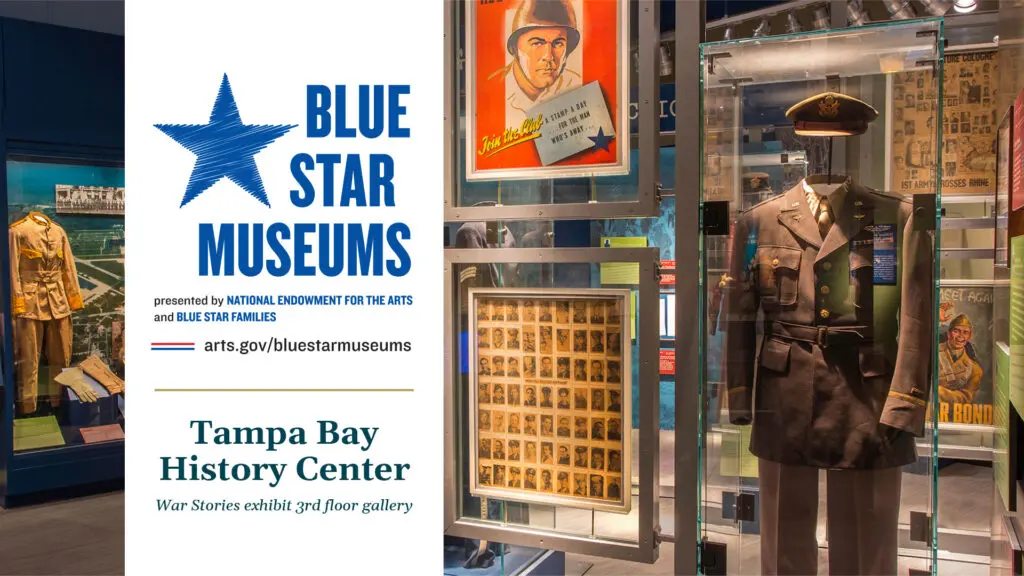
This summer, currently serving military personnel and their families can visit the Tampa Bay History Center for free through the 2026 Blue Star Museums program.
The national program began on Armed Forces Day, Saturday, May 16, and continues through Labor Day, Monday, Sept. 7. The History Center is proud to participate again this year, offering military families an opportunity to explore Tampa Bay’s history, spend time together and connect with the stories that shaped the region.
Blue Star Museums is a national appreciation program presented by the National Endowment for the Arts and Blue Star Families in collaboration with museums across the country. Each summer, participating museums offer free admission to military families as a way to thank them for their service and share America’s cultural treasures.
Why the History Center participates
The Tampa Bay History Center is proud to participate in Blue Star Museums because access to history matters.
Military families often carry the demands of service across cities, states and seasons of change. A museum visit offers time together, a connection to the surrounding community, and an opportunity to see how local stories fit into the larger American experience.
Through Blue Star Museums, the History Center helps expand access to education, reflection and family learning for those who serve. It is one way we can honor service members and their families while supporting the broader national effort to make arts, culture and history more accessible to military-connected communities. The Blue Star Museums program is an extensive network of free access for over 2000 museums, including art, history, children’s museums, zoos and nature centers.
As communities across the country mark 250 years since 1776, the program also offers a meaningful opportunity to consider the nation’s history through the lens of local stories, civic memory and public service.
Who is eligible?
Free admission is available to those currently serving in the U.S. military, including the Army, Navy, Air Force, Marine Corps, Space Force and Coast Guard, as well as members of the National Guard and Reserve, U.S. Public Health Service Commissioned Corps and NOAA Commissioned Corps.
Eligible service members may bring up to five family members through the program. A family member of active duty military may include a spouse or child, aunts, uncles, grandparents, etc.
Qualified guests should present a valid military ID upon arrival and see a Visitor Services associate for admission. Accepted forms of identification include a Geneva Convention common access card, DD Form 1173 ID card or DD Form 1173-1 ID card.
What families can explore
Families can explore Florida’s first peoples, the Seminole story, Spanish exploration, maritime history, early cartography, Tampa’s cigar industry, immigrant neighborhoods, civil rights history and the growth of the modern city.
The galleries are especially useful for families who want a better look at local and regional history shaped by water, trade, military movement, migration, agriculture, industry and cultural exchange.
A closer look at War Stories
For visitors curious about regional military history, War Stories is a strong place to start.
Located on the third floor, the exhibit introduces Tampa Bay’s military past through objects, images and interpretive panels. Visitors do not need deep background knowledge before entering the gallery. The material gives them a visual way in: uniforms, officers’ caps, boots, gloves, weapons, posters, portraits, maps, photographs and timelines.
A large blue entry panel introduces the local impact of conflict. Nearby cases hold military uniforms and service-related objects. War posters show how civilians were encouraged to support military efforts from home. A ship’s wheel points to Tampa Bay’s maritime connections. Group portraits of servicemen bring individual faces into view.
The exhibit includes references to Fort Brooke, the Seminole Wars, the Civil War, the Spanish-American War, World War I, World War II and MacDill Air Force Base. Together, these materials offer a starting point for understanding how military history touched Tampa Bay across generations.
Throughout the gallery, posters promoting war bonds and stamp purchases show how wartime service extended into daily life; families, workers and local communities were asked to participate in ways that were financial, emotional and supportive of the war effort.
Before you go
The Tampa Bay History Center is located at 801 Water St. along Tampa’s Riverwalk and is open daily from 10 a.m. to 5 p.m.
Families can explore the museum’s permanent galleries, view rare maps and artifacts, and learn about the people, places and events that shaped Tampa Bay. Before or after a visit, guests can also enjoy the surrounding Riverwalk area, including nearby parks, restaurants and waterfront views.
Blue Star Museums admission is available at the History Center through Monday, Sept. 7.

About the Author
Sara Cheesewright serves as Digital Marketing Associate at the Tampa Bay History Center. She holds a Master of Arts from St. John’s University and brings more than five years of editorial expertise to her work. As a lifelong storyteller, she is deeply...