
3 Tampa landmarks and their local legends
Mysterious faces in hotel windows, a figure in military uniform and a special movie theater seat visited by an apparition in a fedora. Legend has it that music and laughter can be heard in historic hotels when no one is really there and stories have been passed down of lights flickering and mysterious figures appearing in hallways of some of the oldest historic buildings in Tampa.
Are there spirits in Downtown Tampa? Tampa today bears little resemblance to the city of the first half of the 20th century. But a handful of buildings have remained through the decades, carrying their history with them as the city around them changed and, according to local legends, the stories associated with those buildings have changed, too.
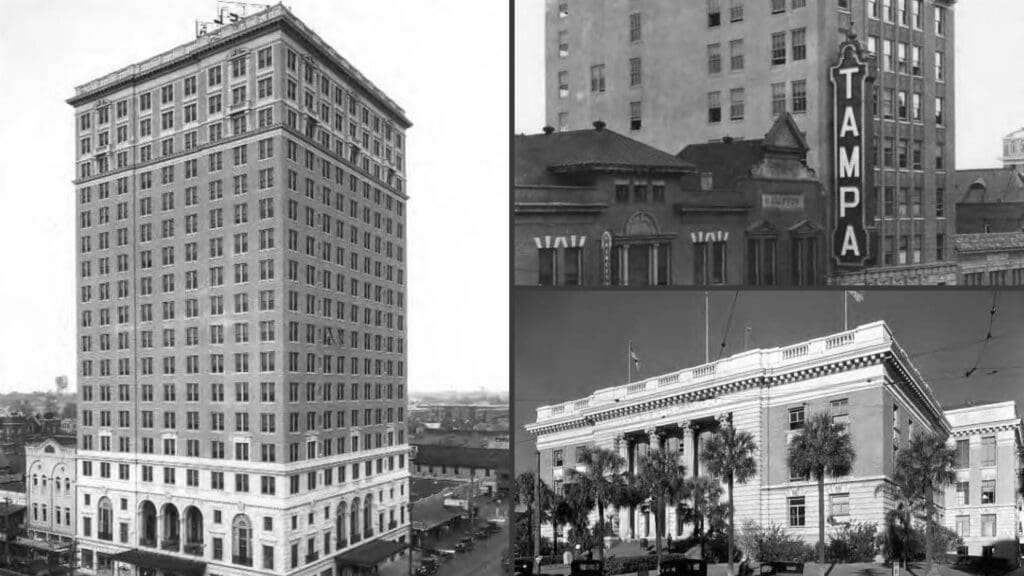
The Floridan Hotel, now Hotel Flor Tampa Downtown; the Tampa Theatre; and the Old Federal Courthouse, now Le Méridien Tampa, are rumored to be haunted.
Tampa landmarks and their unexplained tales

The Old Federal Courthouse: From federal courtroom to hotel
Charlie Wall, the Bolita Kingpin, American businessman and mobster known as the “Dean of Tampa’s early underworld,” is the subject of a local ghost tale tied to the Le Méridien Tampa hotel.
Today, locals and people from out of town visit and stay at the Le Méridien Tampa hotel, but back in the day it was Tampa’s Federal Courthouse.
Constructed between 1902 and 1905 and designed under the guidance of James Knox Taylor, supervising architect of the U.S. Department of the Treasury, the four-story Beaux-Arts building was originally built to house Tampa’s post office but also served as a courthouse and customhouse.
Well-known mobster Charlie Wall was the star witness during the Kefauver Committee hearings in 1950, taking place right inside the walls of the courthouse. Wall spoke about Tampa’s criminal underworld, shedding light on his own criminal past and speaking out about illegal activities across Tampa.
From 1984 to 1998, this building was used exclusively to house the Tampa Division of the Middle District. For more than a century, the building served a variety of federal and civic functions. In 1998, the court moved to a new, larger building: the Sam M. Gibbons United States Courthouse.
In 2003, it was transferred to the City of Tampa through the Historic Surplus Property Program. The building had been vacant for 13 years when a developer entered into a long-term lease with the city and began its rehabilitation using historic tax credits.
Many of the courthouse’s original features were preserved during the renovation. Former offices and judges’ chambers were converted into guest rooms. The courtroom was repurposed as the Courthouse Ballroom. The granite wall that once enclosed the prisoner arrival now serves as a privacy wall for the hotel pool.
The property reopened in 2014 as Le Meridien Tampa, a 130-room boutique hotel. Today, the historic courthouse operates as a hotel, wedding and event venue, and restaurant, with its former courtrooms and architectural details incorporated into the property.
Anecdotal stories have been told about the ghost of Charlie Wall and how he has been seen haunting the front steps of the former courthouse and in the halls.
The Floridan Hotel: A hotel, a residence and a haunted past
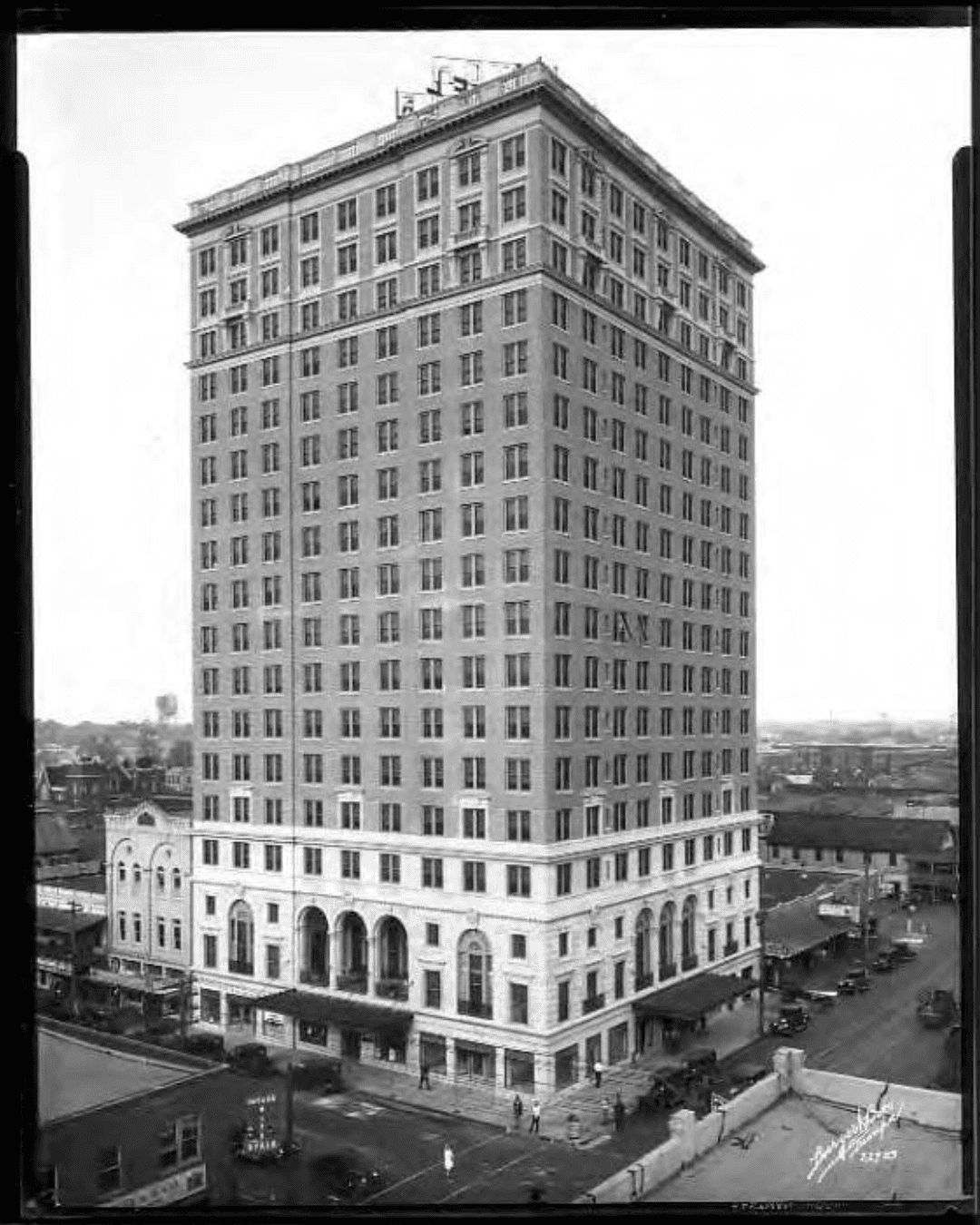
The Hotel Flor Tampa Downtown, formerly the Floridan Hotel and Floridan Palace Hotel, is rumored to be haunted.
Located between Cass and Tyler streets in Tampa, the hotel was designed by Tampa architects G.A. Miller and Francis J. Kennard. It officially opened in 1927 with 316 rooms at a cost of $1.9 million. At 19 stories, it was the tallest building in Tampa for decades.
The Floridan quickly became a prominent downtown hotel and hosted notable guests including Clark Gable, Jimmy Stewart, Charlton Heston and Jack Dempsey. Gary Cooper stayed at the hotel while filming Hell Harbor, and Elvis Presley stayed at the Floridan in 1955.
By the mid-1960s, the hotel was no longer operating as a traditional hotel and had been converted into small studio apartments with kitchenettes. By the 1980s, rooms were being rented by the week or month, and the building had become a residence for transients. Social workers also rented rooms for people experiencing homelessness.
It was during this period that reports of unexplained activity became associated with the building. Residents reportedly heard music and laughter in the hallways, saw electric lights flicker, and found radio dials moving on their own. Faucets were also said to turn on and off without explanation. These accounts became part of the hotel’s folklore and were reported as unexplained incidents and possible paranormal encounters.
In 1985, the Floridan closed due to fire code violations. The building remained vacant for more than 20 years. Even during the period of vacancy, people cited that lights appeared in the windows and faces were seen looking out from the building.
In 2005, Antonio Markopoulos purchased the property for $6 million and invested more than $20 million in renovations. The building reopened in July 2012 as the Floridan Palace Hotel.
In 2022, owner and operator 1754 Properties LLC announced plans for further renovations and the hotel’s affiliation with Hilton’s Tapestry Collection. In January 2024, the property reopened as Hotel Flor Tampa Downtown, Tapestry Collection by Hilton. Today, the historic hotel has 210 rooms, 14 floors and four restaurants. The former Sapphire Room is now The Dan.
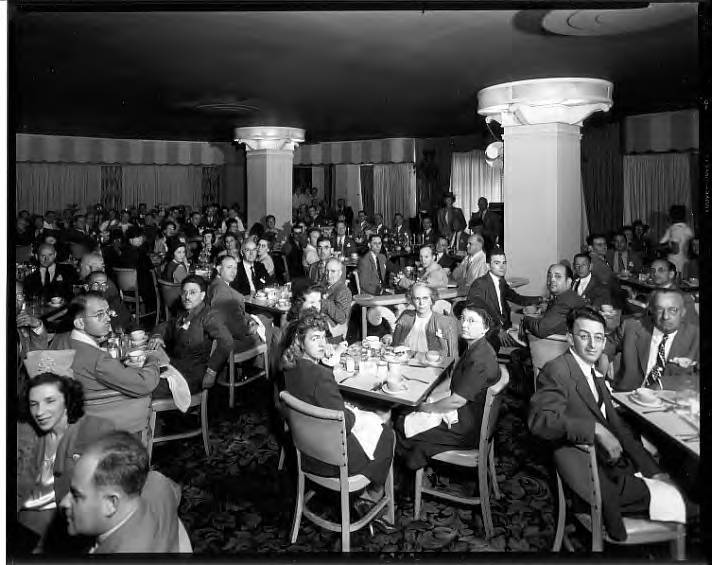
November 19, 1946, Tampa, Fla. Burgert Brothers Collection. Courtesy of the Tampa-Hillsborough County Public Library.
The Sapphire Room has its own place in the hotel’s folklore. In the 1920s, the lounge was a popular gathering place and was frequented by local gangster Charlie Wall.
One of the most enduring stories connected to the room concerns Col. Clarence Tinker, an Osage Native American and the first U.S. Army general to die in World War II, who was rumored to appear in the Sapphire Room in uniform, holding a drink in his hand.
Those who claim to have encountered Tinker’s ghost describe a dark-haired young man in a military uniform, sitting at a small table in the corner between the bar and the piano with a drink in his hand. The account is part of the hotel’s long-standing ghost lore; no historical evidence establishes that the apparition is actually Tinker.
The building itself has undergone a documented series of transformations: from one of Tampa’s grandest hotels in the 1920s, to studio apartments and weekly rentals, to a vacant building, and the restored hotel that stands downtown today.
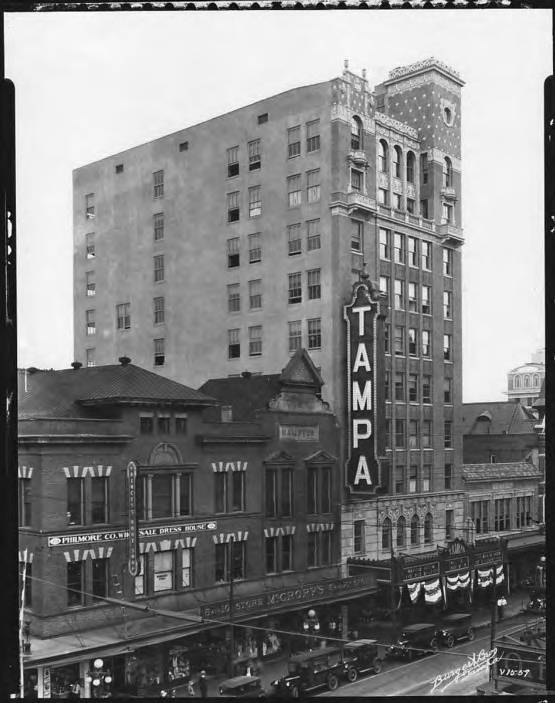
Tampa Theatre: A movie palace with a haunted history
The Tampa Theatre has a reputation for unexplained activity.
Located on Franklin Street, the Tampa Theatre opened on Oct. 15, 1926. Designed by Chicago-based theater architect John Eberson and built by Paramount Pictures, the theater was one of the country’s most elaborate movie palaces of its time. Since opening, the theater has also been the subject of longstanding stories about ghostly visitors and unexplained activity.
Visitors have reportedly seen a woman in a long white dress moving through the theater and along the balcony before disappearing. Rumor has it the Woman in White was Marie Cosler, who was struck and killed by a streetcar on Franklin Street a few weeks before Tampa Theatre broke ground.
By the 1950s, the theatre was losing popularity; audience volume had decreased while costs had increased.
In 1973, the building was scheduled for demolition, but Tampa residents, community leaders and the City of Tampa worked to save and preserve the building. The City Council struck a deal to purchase the theater. Tampa Theatre reopened in January 1977. It was added to the National Register of Historic Places in 1978 and designated a Tampa City Landmark in 1988.
Foster “Fink” Finley, the Tampa Theatre’s projectionist, Tampa, Fla. Photo Courtesy of the Tampa Theatre.

The first known published report of paranormal activity appeared in The Tampa Times in an issue published Thursday, Sept. 28, 1978. Titled “Phantom of the Tampa Theatre,” Times staff writer Bill Warren described reports of Foster “Fink” Finley, the legendary ghost of the Tampa Theatre. Foster “Fink” Finley worked as a projectionist at Tampa Theatre from 1930 to 1965. Accounts of his death and the activity attributed to him have become part of the theater’s ghost lore. Since his death, people who have worked in the booth have reported unexplained activity. According to the legend, Fink’s ghost remains in the theater.
Rumors also surround Seat 308, which has been described as a paranormal hotspot. Only one person has reported seeing the man associated with the story: Tampa Theatre’s former director, who described seeing a man in a fedora sitting in the seat when the theater was closed. The identity of the man has not been established.
“People love hearing the spooky stories, and our Ghosts of Tampa Theatre Tours sell out as fast as we can schedule them. But to me, learning more about the people behind the stories, digging through newspaper archives and public records, and putting the pieces together is just as much about preserving the history of Tampa Theatre as it is about giving folks a fun little scare,” said the vice president, director of marketing and community relations for Tampa Theatre.
Today, Tampa Theatre is operated by the nonprofit Tampa Theatre, Inc. and hosts more than 1,000 events each year, including first-run and classic films, concerts, special events, tours and educational programs.
Haunted places or old buildings?
When the Florida humidity begins to calm and the Tampa heat slowly gives way to cooler evenings, old stories begin to circulate. A neighbor mentions a figure seen on the steps of the Old Federal Courthouse. Someone insists they caught a face in the window of The Floridan Hotel while driving home.
A friend recalls the strange feeling of walking through the Tampa Theatre after dark. One account becomes another, details shift in the retelling and eventually these rumors become part of a building’s lore.
The Tampa Bay area has accumulated its share of legends, folklore and unexplained tales, many of them attached to places that have stood long enough for generations of people to give them stories of their own. Whether these accounts are accepted as folklore or paranormal truth, however, that’s up to you to decide.
Curious about exploring local history and old building on foot? Immerse yourself in hands-on history and walk the streets with one of our expert walking tour guides who can teach you about insider stories, little-known parts of history and how Tampa came to be. Walk the city streets and explore everything from brick sidewalks that span a century or new murals paying homage to a moment in local history. Learn more.

About the Author
Sara Cheesewright serves as Digital Marketing Associate at the Tampa Bay History Center. She holds a Master of Arts from St. John’s University and brings more than five years of editorial expertise to her work. As a lifelong storyteller, she is deeply...