
Tampa’s historic cemeteries: The lives before us
Beneath the sandy soil in Tampa’s cemeteries lie thousands of people who knew this city before we did. They worked in its factories, raised children in its neighborhoods and buried people they loved. Some crossed an ocean to get here. Others served aboard ships, held public office or lived in slavery or segregation. Their lives unfolded along streets you may have walked and across land you may have traveled.
Whether Tampa is your hometown or a place you are just visiting, its cemeteries offer a way to understand what you see around you. Ybor City’s remaining cigar factories once employed workers who helped their families voyage to America for a better life. The heat and rain of Florida once helped mosquitoes thrive, allowing yellow fever to spread through communities like Tampa. A local neighborhood that many drive by is actually a burial ground whose names are still being recovered.
Centro Asturiano, Oaklawn and Zion are three cemeteries you should know about in order to peek into the lives of those who lived here a century ago and beyond.
Centro Asturiano Cemetery: A final resting place for Tampa’s Spanish immigrant community
From Asturias, Spain to their final resting place in Tampa, Florida
At the beginning of the twentieth century, an undertaker might have marked the grave of a cigar worker who spent his days in one of Ybor City’s factories, delicately hand-rolling cigars. During his lifetime, he may have emigrated from Asturias, Spain, amid a growing wave of Spanish immigration to Tampa. Many immigrants arrived during this period. They established themselves in the city and later sent for their families, building new lives alongside immigrants from places such as Cuba.
Like many Spanish immigrants of this time, such a worker may have been laid to rest at Centro Asturiano Cemetery, established for members of the popular social club known as Centro Asturiano. Many of the people buried there lived versions of this story: leaving their homeland, finding work in Tampa’s cigar industry, and building lives within a growing immigrant community.
Today, if you are driving along North Tampa Street or making your way home on Dr. Martin Luther King Jr. Boulevard, you might feel curious and turn in by Centro Asturiano Cemetery. The original cemetery is the final resting place of approximately 601 people. Centro Asturiano’s first cemetery is here, adjacent to the city-owned Woodlawn Cemetery. However, they own a larger cemetery off of MLK and 56th Street.
If you step out of your car and explore the grounds, you will find aluminum fencing bordering the cemetery. Sabal palm fronds lean over headstones that have endured more than a century of Tampa’s rainy seasons. Weave your way through the cemetery and you can find the grave of Centro Asturiano founder Antonio Gonzales Prado, who was laid to rest there in 1904.
Together, the two burial grounds preserve part of the story of Tampa’s Spanish immigrant community: people who established roots in a new city, built a strong social organization and became part of Tampa’s cultural history.
Oaklawn Cemetery: Tampa’s divided communities in one location
War, disease, slavery and political office: these Tampa residents rest together
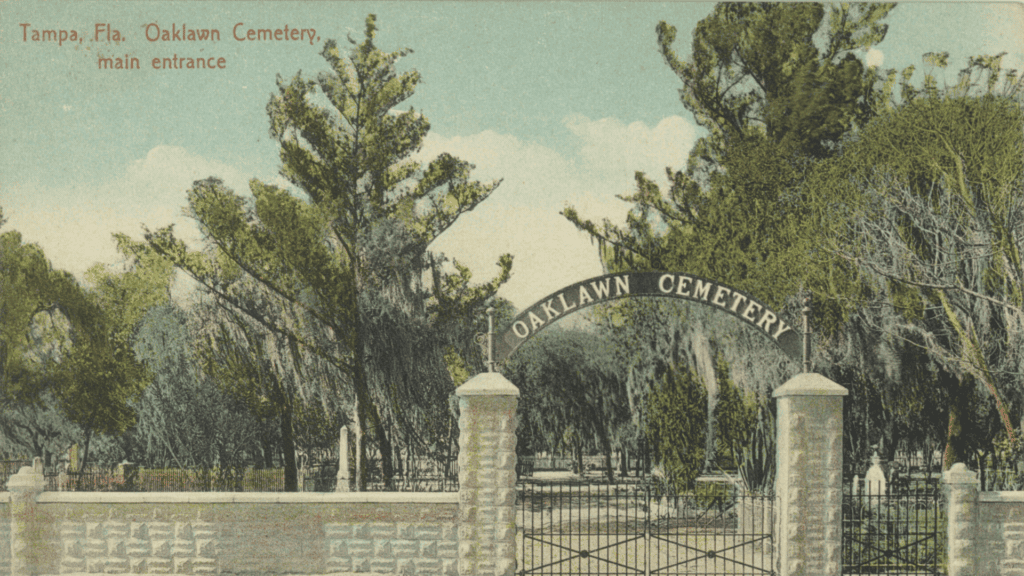
Established in 1850, Oaklawn is Tampa’s oldest public burial ground. Its history holds people from different backgrounds: pirates, Confederate soldiers, enslaved people, victims of yellow fever, several mayors and a governor. The grounds also include the adjoining Catholic St. Louis Cemetery, where Don Vicente Martinez Ybor is entombed. Oaklawn was designated for people described in the records as “white and slave, rich and poor.” Its sections reflected the racial and economic divisions of the time, even as people from different worlds came to rest within the same burial ground.
If you are exploring the grounds, you may notice the inscription on a headstone, “Lawyer, Circuit Judge, Fla. Supreme Court Justice, Governor of Florida 1893-1897.” This grave belongs to Henry Laurens Mitchell, the only state governor to be buried at Oaklawn. You may also encounter the gravesite of Tampa’s first mayor, Joseph B. Lancaster.
Oaklawn’s burial grounds include ship captains, Indigenous people and soldiers. Among those buried here is James McKay Jr., a ship captain who worked for the Mallory Line and later served as Tampa’s mayor.
One marker identifies an unnamed person enslaved by the Lesley family who died in 1850. It records the enslaving family’s surname but not the actual identity of who is buried in the grave.
Military markers commemorate Confederate soldiers and four unidentified soldiers of the U.S. Army’s 4th Infantry stationed at Fort Brooke. According to their inscription, the four died around 1825 and were reinterred at Oaklawn in 1996. A memorial also honors Sgt. John James Miller Jr., a Marine killed on Saipan during World War II whose remains are buried in Honolulu.
Another memorial records deaths associated with disease rather than military service.
You may notice a memorial to residents whose lives ended during Tampa’s yellow fever epidemics. The stone commemorates victims of outbreaks in 1853, 1858, 1867, 1871 and 1887-1888 who are buried in Oaklawn. The cemetery contains a mass grave holding an unknown number of yellow fever victims. During the epidemic, residents buried victims together, hoping to prevent the spread of the disease.
Spread through the bites of infected mosquitoes, yellow fever repeatedly struck Tampa during the 19th century. People who became ill could develop fever, chills, headaches, muscle aches and vomiting. In severe cases, the virus damages the liver, causing the skin and whites of the eyes to turn yellow. This yellowing gave the disease its name. Some people died within days of becoming ill.
Tampa’s warm, humid climate helped mosquitoes thrive, while water collected around homes provided places for them to breed. Yellow fever no longer circulates locally, but the environmental conditions that support mosquitoes remain. Other mosquito-borne diseases are present in our tropical environment today.
The cemetery is open daily from 8 a.m. to 6 p.m. and the History Center often leads guided tours with historian Fred Hearns from 10 to 11:30 a.m. Hearns connects these burial sites to Tampa’s development, examining Black history, slavery, civic leadership and the communities represented within the cemetery. Learn more about our current walking tour schedules by visiting our event calendar.
Zion Cemetery: A segregation-era burial ground, forgotten and rediscovered
Rediscovering a lost piece of Tampa’s Black history
You cannot visit Zion Cemetery. Not yet.
“The Historic Zion Cemetery site (1901-1923) in Tampa Heights currently is not accessible to the public. It is surrounded by a six-foot canvas piece of art that lists hundreds of names of Black people buried there. The canvas is visible on the east side of the 3700 Block of N. Florida Avenue. The memorial site may be accessible to the public in the future,” said Fred Hearns, Curator of Black History.
But why would a cemetery be closed to the public?
Zion Cemetery was only recently rediscovered after decades of development concealed the burial ground.
For decades, Tampa residents drove past Zion Cemetery without knowing it was there. They knew the site as Robles Park Village, a neighborhood built over a burial ground where hundreds of people had been laid to rest.
Established in the early 20th century, Zion was Tampa’s first official African American, segregation-era cemetery covering approximately 2.5 acres. As Tampa developed, the cemetery was eventually built over. In 1951, Robles Park Village was developed on a 35-acre site, with 433 residential units across 67 buildings. Over time, part of the housing development encroached on the historic burial ground.
In 2019, the Tampa Housing Authority commissioned a Phase I Environmental Site Assessment that confirmed approximately 1.5 acres of Robles Park Village overlapped with the original Zion Cemetery site. Further investigation led to the discovery of more than 120 people buried beneath the property.
The discovery brought renewed attention to the people buried at Zion and to the history of Tampa’s African American community. Descendants, historians, advocates and the city have since worked to acknowledge the burial ground and protect it from further loss. To learn more about the detailed timeline of Zion’s history, Tampa Bay Times reporter Paul Guzzo wrote about it here.
Genealogical research conducted through the USF Living Heritage Institute identified a total of 712 burials at Zion Cemetery. The final genealogical report, according to USF genealogist Rue Lynn Galbraith, documents the individuals identified through the research.
Looking closely at this research, the occupations of those who were buried at this location included careers like foreman, housekeeper, tailor, midwife, school teacher, sailor, nurse, cigar worker, saloon keeper, clerk, brick plant laborer, and many more. Little by little, the stories of those who were buried in Zion are coming together.
In April of 2026, Tampa City Council unanimously approved a land-swap agreement that began the process of placing part of the cemetery site under city control so it can be properly preserved.
Today, efforts to protect Zion Cemetery continue, allowing Tampa to restore a place that was once overlooked to its original purpose: a sacred place of rest, remembrance and recognition for the lives buried there.
History is happening now
At Centro Asturiano, leaving Spain became a life in Tampa and, eventually, a final resting place. At Oaklawn, families buried their dead after epidemics and wars, leaving names and dates we can still read and learn about today. At Zion, people are searching for those details now, recovering the identities of residents who helped keep Tampa going while segregation shaped daily life.
The city continued to grow around these people’s graves and sometimes over them. How we preserve and maintain yesterday’s history is part of the job we are responsible for today.
There is still much to uncover before Zion Cemetery’s history becomes as familiar as the stories of Tampa’s factories, ships and neighborhoods. We live on ground they once called home. Whether their resting places remain known and cared for is up to us to foster.
In the spirit of remembrance, historians, genealogists, archivists, historical societies and ordinary people all across the Tampa Bay area work together to make sure that the past is well remembered, actively sought after and preserved. At the History Center, our mission is exactly that: to discover, preserve and learn from our region’s past to inform our common future.
If you would like to preserve and support Florida’s past, you can learn more about becoming a patron of history by joining our membership.

About the Author
Sara Cheesewright serves as Digital Marketing Associate at the Tampa Bay History Center. She holds a Master of Arts from St. John’s University and brings more than five years of editorial expertise to her work. As a lifelong storyteller, she is deeply...