
The Tampa Bay Timeline and the stories locals preserved
The Don Cesar, then and now
In 1928, the Don Cesar opened on St. Pete Beach. The Don CeSar debuts as a beachfront hotel and thereafter becomes a landmark with its iconic pink hotel that stood out along the Gulf shoreline. Guests from all over Florida stopped for a night or two upon the popularization of this iconic hotel.
Ninety-seven years later, in March 2025, the pink palace reopened after a season of hurricane damage. Today, it draws visitors from across the country, while locals return for dinners, gatherings and celebrations by the water.
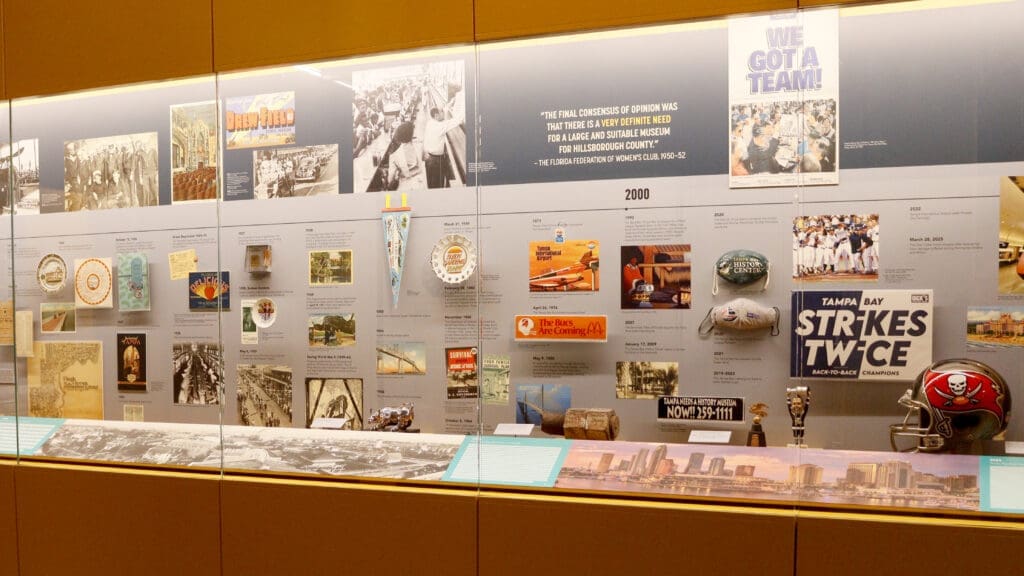
Visitors of the Tampa Bay History Center can view a Don CeSar postcard on the Tampa Bay Timeline exhibition to experience a glimpse of what 20th-century regional tourism and development looked like.
Unveiled at the Tampa Bay History Center’s Jan. 30, 2026, ribbon-cutting ceremony, the exhibit allows visitors to encounter the full sweep of local history on a digestible scale.

How everyday Tampa fits together
The Timeline helps visitors understand how separate moments in regional history relate to one another. Many people encounter local history in fragments: a favorite coffee shop they frequent in Ybor that dates back to the 1960’s, a daily drive over the Gandy bridge, a family attic with postcards and boxes of Buccaneer jerseys, or traditions of celebrating Gasparilla every year with friends. That is exactly why a timeline is so ideal for the Tampa Bay History Center.

The Tampa Bay Timeline places the region in historic context and is designed as both an introduction for newcomers and a point of reflection for longtime residents. The exhibit offers an overview of Tampa Bay’s past while prompting visitors to connect the timeline to neighborhoods across the map, to local institutions that are household names, and to industries that family and friends take part in.
How the Timeline was chosen
Behind the exhibition is a curatorial question: how where it’s themes, objects and chronology determined?
“It was difficult to decide what to include. With more than 100,000 objects in the collection and limited gallery space, the Timeline was carefully curated to reflect the many industries, communities and events that shaped the Tampa Bay area, rather than reduce its history to a single story,” said Michelle Hearn, Director of Curatorial Affairs.
The timeline includes Tampa, St. Petersburg and surrounding communities to show how the Tampa Bay region took shape.
“The History Center has collected objects that the people of Tampa Bay area chose to preserve. Our collection exists because this community has participated in its own history and record-keeping. What appears on the Timeline is shaped by the gaze of local natives and what they have valued over time,” said Hearn.
From fossils to founding institutions: regional history through objects
Natural history, artifacts and chronology
The oldest relic within the Tampa Bay Timeline dates back to before human habitation in the region, with an ammonite fossil that dates to at least 66 million years ago. This ancient marine specimen points to the deep natural history of the region and reminds visitors that the Tampa Bay area’s story begins long before surrounding areas became modern communities.
From there, the exhibit moves through a chronological arc grounded in postcards, advertisements, maps, statues and unique artifacts from the History Center’s permanent collection. Rather than reducing the exhibition to dates and milestones, the Timeline uses objects to show how national and regional developments shaped daily life in the Tampa Bay area over time.
The exhibit includes more than 75 carefully selected artifacts drawn from the History Center’s permanent collection of more than 100,000 objects.
Seminole life, immigration and Gasparilla
Visitors can follow the area’s history through Seminole life, the cultural influence of Cuban and Spanish immigrants, and civic traditions that still shape regional identity. Among the objects on view are Seminole trade beads and military buttons from Fort Brooke, tangible links to Indigenous communities and early military life in the area. Seminole history can also be found throughout the gallery space, including within Florida’s First People, the Knight collection, and many other threads of regional history.
In 1904, Tampa held its first Gasparilla Pirate Festival and its first Florida State Fair. Among the objects on display are an invitation to the Gasparilla Royal Ball from 1928 and a dance card for the Ye Mystic Krewe’s Reception Coronation Ball from 1938. Together, they place Gasparilla in its earlier civic life while showing the staying power of a tradition that remains part of Tampa’s identity. Gasparilla continues as an annual celebration, with Tampians taking part each year.
Port development, urban growth and city form
The Timeline also follows a working port city into the urban center known today, shaped by population growth, major transportation infrastructure, commercial expansion, large-scale real estate, and the mix of business, leisure and waterfront life that made it a major destination. Those broader changes are grounded in objects that show how Tampa’s traditions, systems and institutions took shape in their own time and remain recognizable today.

The 20th century and beyond bring into focus the forces that shaped the Tampa Bay area residents know today. Port activity, electrification, military presence, tourism, and large-scale commercial and residential growth all helped define the region’s present form. The Timeline continues through 2025 and concludes on a statue of the fictional Don CeSar, generously donated by the Don CeSar Hotel.
Electric power, leisure life and lasting institutions
The Timeline also highlights the industries and systems that helped build the Tampa Bay area. Visitors can follow the rise of defining sectors such as cigar manufacturing, hotel development, restaurant culture, professional football and professional baseball.
Among the objects on display is a light bulb from a 1911 Tampa Electric Company executive Christmas dinner, with the evening’s menu printed on its surface. More than a novelty, it points to TECO’s early role in building the electrical infrastructure that supported homes, businesses and transportation across the Tampa Bay area. Founded in 1899 by Peter O. Knight, the Tampa Electric Company became a major regional utility and remains a household name today.
What Tampians preserved
For the History Center, this permanent installation reflects a clear belief about public history: regional change should be understood through the lived experiences of the people who made it. Public history should connect a place’s history to ordinary life, not only to governments, academic interpretation or major institutions. Curator Michelle Hearns and her team shaped the Tampa Bay Timeline around that idea. The result is an exhibition built through local memory, preserved objects and lived experience rather than a top-down account of the past.
The museum set out to tell the story of Tampa Bay not just as it was recorded, but as it was lived. Through labor. Through migration. Through commerce, neighborhoods and community life. Rather than focusing only on political leadership or major turning points, the exhibition looks to the workers, families, industries and places that gave the region its character. Cigar workers in Ybor City and West Tampa are part of that story. So are Cuban immigrants and other immigrant communities, Black communities whose labor, institutions and neighborhoods shaped local history. Change took place through tourism, hotels, port activity, military presence and transportation and so much more.
Preserving history through ordinary life required close attention to what people chose to save. Not just official records, but postcards, photographs, documents, keepsakes and artifacts that share local stories. Many of the places and objects represented on the Timeline are still familiar to the people who live here, from a Don CeSar postcard to objects tied to the Gandy Bridge, Tampa International Airport and MacDill Air Force Base.
Through that lens, the Tampa Bay Timeline becomes the people’s history, showing how the Tampa Bay are became what it is today through immigration, labor, trade, tourism, military growth, neighborhood life, celebration and change.
If you have artifacts or documents that may complement the History Center’s collection, please contact the Collections Department at [email protected]. The objects preserved today may one day become part of the historical record that helps future generations understand this region more fully.

About the Author
Sara Cheesewright serves as Digital Marketing Associate at the Tampa Bay History Center. She holds a Master of Arts from St. John’s University and brings more than five years of editorial expertise to her work. As a lifelong storyteller, she is deeply...